Sunday, July 17, 2011

Bias and the BBC

One of the most common complaints levelled at the BBC is that it is biased. Typically, people accuse it of propagating the opposite views to their own. The burden of proof is somewhat slight for many people when they talk about the bias of the BBC – little more than the BBC happens to have said something with which they did not agree. As such, the BBC is placed in an impossible position. It means that the BBC simultaneously has to represent every view in our diverse country or run the risk of being biased. Given the impossibility of the former, therefore, the BBC ends up being accused of the latter.

Furthermore, is there any real way of not being biased? I mean, even if the BBC editorial staff go into a project with an entirely open mind, if there any real way in which anyone can put their innate biases to one side and be completely neutral? I try to be neutral when I read any article or book, but I know that my prejudices and biases lurk in the background. For example, when I read something about Gordon Brown I try to keep an open mind and look at the content of what he says, but I can’t quite get over my natural antipathy towards that ghastly man. I know I am biased, despite my best efforts not to be.

Of course, it doesn’t matter if I am biased – I make no attempt to pretend otherwise. Plus, no-one has any right to really call me on the content of this blog. You don’t pay for it, so you don’t get a say in what I put on here (although you can respond in the comments section, obviously). However, the BBC – at least on some levels –is still presented (and arguably presents itself) as a public service. Part of the issue is that, whether we watch the BBC and its output or not, we still contribute to it if we own a TV through the licence fee. People feel the right to demand neutrality from the BBC because they have little choice but to fund it. The same is not true of every other media outlet that springs to mind. Don’t like the bias of Fox News? Well, you don’t have to pay for it. Likewise, don’t like the bias of The Guardian? You don’t have to buy the paper (not least because you can get the content for free online). Whereas the BBC…

I don’t think we could make the BBC absolutely neutral, and even if we could, I still think that some would deny that neutrality because it is impossible in a pluralistic culture like our own that is filled with incommensurable values to meet the expectations of one and all. So the best thing we can do is remove the demand that the BBC be neutral. So let’s remove the one thing that allows every licence fee holder in this country the feeling that they have a say in the output of the BBC. Quite simply, let’s end the licence fee.

Labels: ,

Thursday, July 16, 2009

The Norwich North "Debate"

Norwich North candidate Craig Murray has got himself into a tizzy about not being invited on to a BBC debate between the "main candidates" in the Norwich North by-election:
The local BBC are broadcasting a live TV debate between the "Four Main Candidates" - none of whom has anything interesting to say - on 22 July at 22.15. I am excluded lest I say something voters might actually care about.
Of course, there's nothing quite like a would-be parliamentarian being slightly petulant to win the voters over. I wonder what Mr Murray will do next - perhaps sit in the corner and rock back and forth, muttering that they are all against him.

However, despite the tone of Murray's post, there is a real problem highlighted by Murray. Firstly, out of 12 candidates, the BBC have selected four to be the main candidates. Why four though? Why not five? Or six? And what selection criteria did they use? Something about past and present electoral history in the area. But what if Labour wasn't in the main four parties most likely to win this election? Would they not be invited to the debate? And what if the BNP or UKIP were one of the four parties riding highest in the polls/electoral history? Both scenarios are a possibility in some areas, but I suspect that Labour would still be in the debate whilst other parties wouldn't get the invite. 

Because these aren't the "Four Main Candidates". These are the representatives of the Four Established Parties. The Four Mainstream Parties. Three of those parties represent a simple maintenance of the status quo with minor tweaks, whilst the Green's represent a mad yet strangely fashionable combination of communism and environmentalism. They are not the future - they represent the past and the really rather crappy present. Whilst the focus on these parties might discount the loopy candidates, it also discounts other small parties who have a valid point to make and who are just starting to contest elections.* Besides, in the interests of free speech, shouldn't the loopy candidates be able to have their say in debate as well?

The grudging concession on the BBC precis of the programme that there will be "comments" from the other candidates in the broadcast does nothing to dispel the gross favouritism shown to the parties of the status quo. You could argue that the BBC is in charge of its own programming, and therefore can decide what to stick on our screens. But the BBC is a public service funded by those who pay the licence fee. And their clear bias in their "debate" creates the perception that there are only four real candidates contesting this election. The reality is somewhat different, and if the people of Norwich North really want a change, then the BBC should be prioritising the views of the lesser known candidates rather than burying beneath the bland statements of the parties of the status quo. 

*Yep, I'm talking about one party in particular here. Obviously. 

Labels: , , ,

Thursday, January 15, 2009

Illustrating Expansion

I'm not one of these people who wants to bang on endlessly about how biased the BBC is. Yeah, I think there probably is a bias there, but I reckon there is a bias at every news source. It is a mark of the readers intelligence that they are able to differentiate the facts of a story from that bias.

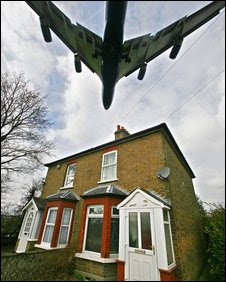
That said, every now and again I see something on the BBC news website that really jars with me. Like this photo, attached to the link to their latest story about expanding Heathrow:

Sweet Jesus, it is difficult to think of a less appropriate image for a story about airport expansion short of posting a picture of 9/11. In that picture the plane looks like it is intimidating the house at best. At worst, it looks like the plane is about to land on the house. Or just crash straight into it. It seems to shriek "if the airport is expanded, then planes will land on your house."

There's going to be a big debate about expanding Heathrow; pictures like this simply do not help that debate.

Labels: , ,